Choosing the right gear system can have a major impact on the efficiency, torque, noise level, speed reduction, and reliability of industrial machinery. Two commonly used options are worm gears and helical gears, but they are designed for different operating conditions.
A worm gear is often selected when high reduction ratios, compact installation, and right-angle power transmission are required. A helical gear, on the other hand, is known for smoother engagement, higher efficiency, and better load distribution in many continuous-duty applications.
ASAR Engineering manufactures both worm gears and helical gearboxes, making it important to understand where each system performs best before choosing one for an industrial application.
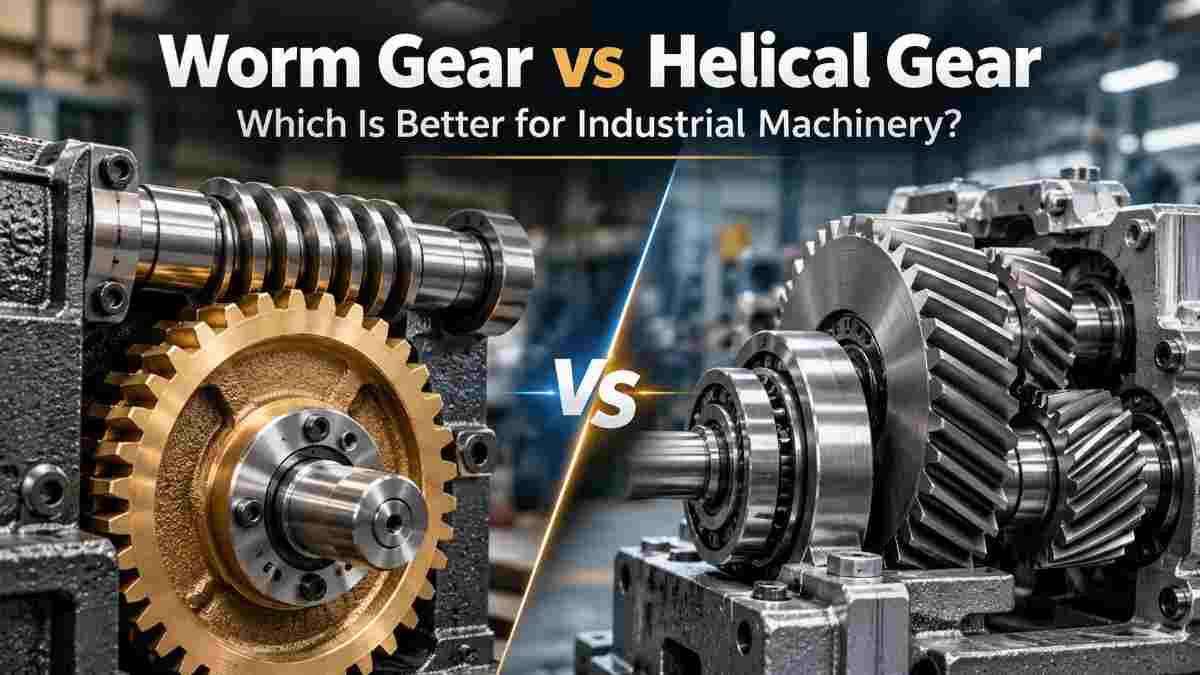
A worm gear system typically consists of a worm, which resembles a screw, and a worm wheel that meshes with it.
The system is commonly used to transmit power between non-parallel and non-intersecting shafts, often at a 90-degree angle.
Worm gears are especially useful when machinery needs a large speed reduction within a compact space.
ASAR Engineering highlights several common characteristics of worm gears, including high gear reduction, smooth operation, compact design, and self-locking behavior in many applications.
Helical gears use teeth that are cut at an angle rather than straight across the gear face.
Because the teeth engage gradually, the load is shared across more than one tooth during operation. This can help reduce vibration and create smoother power transmission.
Helical gears are commonly used in industrial machinery where continuous operation, high torque, and relatively quiet performance are important.
ASAR Engineering’s helical gearbox range is designed for smooth power transmission and is used in applications such as conveyor systems, material handling equipment, and automated machinery.
The main difference lies in the way power is transmitted and how the teeth engage.
Worm gears typically use a screw-like worm that drives a worm wheel at an angle, while helical gears use angled teeth that mesh gradually along the tooth face.
This difference affects:
Worm gears are generally better suited to applications that require a large speed reduction in a single stage.
The gear ratio is determined by the number of threads on the worm and the number of teeth on the worm wheel.
This allows worm gear systems to achieve significant reduction ratios without requiring several gear stages.
This is one reason industrial gearboxes with worm reduction configurations are widely used where low output speed and increased torque are needed within limited installation space.
Helical gears are generally more efficient than worm gears because their rolling contact produces less sliding friction.
In worm gear systems, there is greater sliding contact between the worm and worm wheel. This can increase friction and heat generation, especially under heavy loads or high-speed operation.
For applications where energy efficiency is a major priority, a properly selected helical gear system may therefore be more suitable.
Both systems can transmit high torque, but the best option depends on the required speed, ratio, duty cycle, and available space.
Worm gears are commonly used where a high reduction ratio is needed to increase output torque at lower speeds.
Helical gears are often selected where high torque must be transmitted efficiently and continuously under heavy loads.
ASAR Engineering describes its helical gearbox solutions as capable of handling high torque and strong load-bearing requirements in industrial environments.
Both worm and helical gears can provide relatively smooth operation compared with some straight-tooth gear systems.
Helical gears are particularly known for gradual tooth engagement, which helps reduce shock and vibration.
Worm gears can also operate smoothly because the contact between the worm and wheel is continuous rather than sudden.
The final noise level depends on factors such as:
Worm gear systems generally generate more heat because of the sliding friction between the worm and worm wheel.
This makes lubrication and thermal management especially important in continuous-duty applications.
Helical gears typically have lower sliding losses and can therefore operate more efficiently under many industrial conditions.
Excessive heat in either system can shorten lubricant life and accelerate component wear, so operating temperature should always be monitored.
One of the distinctive advantages of some worm gear systems is self-locking behavior.
Depending on the lead angle, friction, and system design, the worm can drive the worm wheel while the wheel may not easily drive the worm in reverse.
This can be useful in applications where preventing reverse motion is desirable.
ASAR Engineering also identifies self-locking as one of the key characteristics of its worm gear and worm reduction gearbox solutions.
Worm gears can be particularly useful when space is limited.
The right-angle layout allows the input and output shafts to be positioned compactly, while high reduction ratios can often be achieved in a single stage.
This makes worm gear systems suitable for machinery where a long multi-stage gearbox would be impractical.
Helical gears are often preferred for continuous-duty machinery because of their higher efficiency, smoother engagement, and good load distribution.
They are commonly used in applications such as:
These applications often require reliable power transmission over long operating periods.
Worm gears are suitable for applications that require compact construction, high reduction ratios, and right-angle power transmission.
Typical applications may include:
They can also be used where controlled low-speed output is more important than maximum transmission efficiency.
Helical gears are widely used across industrial machinery because they can transmit power smoothly and handle substantial loads.
Common applications include:
They are also part of broader industrial transmission gear systems used to control speed and torque in heavy-duty machinery.
Both worm gears and helical gears require proper lubrication, but worm gears can be particularly sensitive because of their higher sliding friction.
Insufficient lubrication may increase:
The lubricant should always be selected according to the gear material, operating temperature, speed, load, and manufacturer recommendations.
Common causes of worm gear failure can include:
Routine inspection can help identify early signs of wear before they lead to major equipment downtime.
Helical gear problems can also develop because of operating or maintenance issues.
Common causes include:
Proper gear alignment, lubrication, and load control can significantly improve service life.
The choice should be based on the operating requirements of the machine rather than selecting one gear type universally.
Consider:
Worm gears are generally more suitable when very high speed reduction, compact right-angle installation, or self-locking behavior is required.
Helical gears are often better when higher efficiency, continuous operation, smooth power transmission, and heavy load capacity are priorities.
There is no single option that is best for every machine.
Choose a worm gear when your application requires compact installation, high reduction ratios, smooth low-speed operation, or resistance to back-driving.
Choose a helical gear when you need efficient power transmission, high load capacity, smooth operation, and reliable continuous-duty performance.
ASAR Engineering manufactures worm gears, helical gearboxes, industrial gearboxes, and industrial transmission gears for a variety of heavy-duty applications. Selecting the right configuration based on speed, torque, ratio, and duty cycle can help improve machinery performance and component life.