Are worn or seized conveyor return rollers causing belt damage, vibration, or unexpected downtime? Ordering replacements without checking the original dimensions can result in installation problems and premature failure.
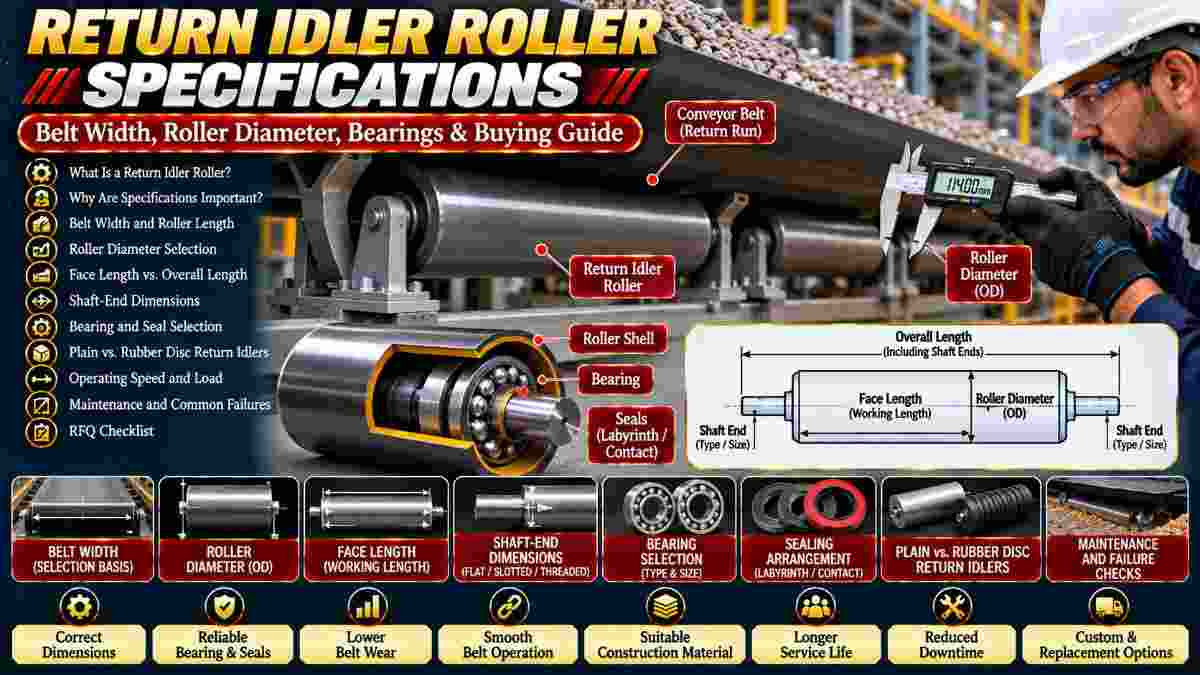
The essential return idler roller specifications include belt width, roller diameter, face length, shaft dimensions, bearing type, sealing arrangement, mounting configuration, and operating conditions.
Asar Engineering Pvt. Ltd. offers industrial idler rollers for conveyor and bulk material handling applications.
A return idler roller supports the unloaded section of a conveyor belt as it travels back toward the tail pulley.
Return rollers are usually installed beneath the conveyor structure.
They help support the belt's weight and reduce sagging along the return path.
Common applications include:
Mining conveyors.
Cement plants.
Warehousing facilities.
Aggregate processing.
Industrial material handling.
Explore Return Idlers for product information.
Correct specifications ensure that replacement rollers fit the existing frame and operate within the conveyor's mechanical requirements.
Incorrect dimensions may cause:
Mounting difficulties.
Uneven belt support.
Excessive vibration.
Bearing overloading.
Belt-tracking problems.
Premature roller wear.
Buyers should verify the existing conveyor arrangement before ordering.
Conveyor belt width helps determine the required roller face length and support arrangement.
A roller must provide adequate support while fitting the installed conveyor frame.
Important information includes:
Nominal belt width.
Roller face length.
Frame mounting width.
Belt-tracking requirements.
Existing roller configuration.
Belt width alone is insufficient to identify an exact replacement.
Roller diameter is measured across the outside surface of the cylindrical roller shell.
Measure an unworn section of the roller using a suitable instrument.
Common industrial roller diameters include 89 mm, 114 mm, 127 mm, and 152 mm, although available sizes vary by manufacturer.
The replacement diameter should match the approved conveyor specification.
Face length is the working length of the cylindrical roller body, while overall length includes the projecting shaft ends.
Both dimensions matter.
A roller with the correct face length may still fail to fit if its shaft extensions are different.
Record:
Roller face length.
Overall shaft length.
Shaft projection at each end.
Mounting-center distance.
Use the original drawing whenever available.
Shaft-end dimensions determine whether the roller fits securely into the existing conveyor brackets.
Common configurations include:
Flat shaft ends.
Slotted or notched ends.
Threaded ends.
Other manufacturer-specific mounting designs.
Verify the shaft diameter, end shape, notch dimensions, and mounting arrangement.
Do not assume rollers with matching outside diameters have interchangeable shafts.
Bearing selection depends on roller loading, operating speed, shaft dimensions, environmental conditions, and the required service life.
Common designs use suitable deep-groove ball bearings.
Important specifications include:
Bearing designation.
Load rating.
Operating speed.
Internal clearance.
Lubrication arrangement.
Bearing housing construction.
Confirm the required bearing model against the original component or engineering drawing.
Seals protect roller bearings from dust, moisture, and contaminants that can reduce bearing life.
Depending on the design, rollers may use:
Labyrinth seals.
Contact seals.
Integrated bearing seals.
Multi-stage sealing arrangements.
Dusty or wet environments may require additional sealing protection.
The appropriate configuration should follow actual operating conditions.
Plain return idlers use a continuous cylindrical roller surface, while rubber disc return idlers incorporate spaced discs to help manage material buildup.
Plain rollers are common in standard return-belt applications.
Rubber disc arrangements may be considered where sticky material remains attached to the belt.
However, persistent material carryback should also be addressed through suitable belt-cleaning practices.
Return idlers support the returning belt, while impact idlers help cushion the loaded belt at material loading and transfer points.
Impact idlers commonly use rubber rings or other cushioning arrangements.
Their functions and loading conditions are different.
Explore Impact Idlers for related conveyor components.
Belt speed and roller loading influence rotational speed, bearing requirements, roller construction, and expected service life.
Check:
Conveyor belt speed.
Belt weight.
Idler spacing.
Roller diameter.
Environmental conditions.
Continuous or intermittent operation.
The complete conveyor design should determine the required roller rating.
Common causes include bearing contamination, misalignment, excessive loading, damaged seals, corrosion, and material buildup.
Warning signs include:
Rollers that stop rotating.
Abnormal noise.
Excessive temperature.
Damaged roller shells.
Uneven belt contact.
Visible corrosion.
A seized roller can damage the moving conveyor belt and should be investigated promptly.
Maintenance should focus on bearing condition, roller rotation, alignment, contamination, and structural damage.
Recommended checks include:
Inspect rollers for wear.
Monitor abnormal noise.
Check mounting brackets.
Examine seal condition.
Identify seized rollers.
Check for material buildup.
Verify belt tracking.
Follow the manufacturer's maintenance instructions.
Always isolate and lock out the conveyor before performing maintenance.
Replacement rollers must match the existing conveyor's dimensional, mechanical, and mounting requirements.
Record the roller diameter, face length, overall length, shaft-end configuration, bearing details, seals, and construction material.
Photographs and an original sample can help confirm compatibility.
Prices depend on roller diameter, length, material, bearing configuration, sealing system, manufacturing requirements, and order quantity.
Special coatings, corrosion-resistant materials, and custom shaft ends may also affect pricing.
Compare supplier quotations using identical technical specifications.
A complete quotation request should describe the conveyor, roller dimensions, construction, operating conditions, and required quantity.
Provide:
Conveyor application.
Belt width.
Roller outside diameter.
Roller face length.
Overall shaft length.
Shaft diameter and end details.
Bearing designation.
Seal arrangement.
Plain or rubber disc configuration.
Material and surface finish.
Belt speed and operating conditions.
Drawing, quantity, and delivery location.
These details help manufacturers evaluate replacement compatibility.
Common buyer questions concern roller sizing, bearings, belt compatibility, and replacement requirements.
No. Roller length, diameter, shaft ends, bearings, and mounting requirements must also be checked.
No. They support different sections of the conveyor belt and may use different configurations.
Custom dimensions and constructions may be available depending on manufacturing capabilities.
A seized roller should be inspected and replaced when it cannot be safely restored to the approved operating condition.
You can request a quotation by sharing your belt width, roller dimensions, shaft-end details, bearing specifications, operating conditions, and quantity.
For replacement applications, provide an existing drawing or sample.
Explore Return Idlers or contact Asar Engineering to discuss your requirements.
Technical Note: Final return idler selection should follow approved conveyor drawings, manufacturer specifications, bearing load ratings, and operating requirements.