Industrial machines often need a flexible connection between rotating shafts so that torque can be transmitted smoothly even when there is minor misalignment, vibration, or shock loading.
An N-Eupex coupling is designed for this type of application. It helps connect two shafts while absorbing vibration and compensating for limited alignment errors that could otherwise place additional stress on bearings, shafts, and connected equipment.
ASAR Engineering supplies N-Eupex couplings along with other industrial power transmission components such as gear couplings, spacer couplings, and transmission systems.
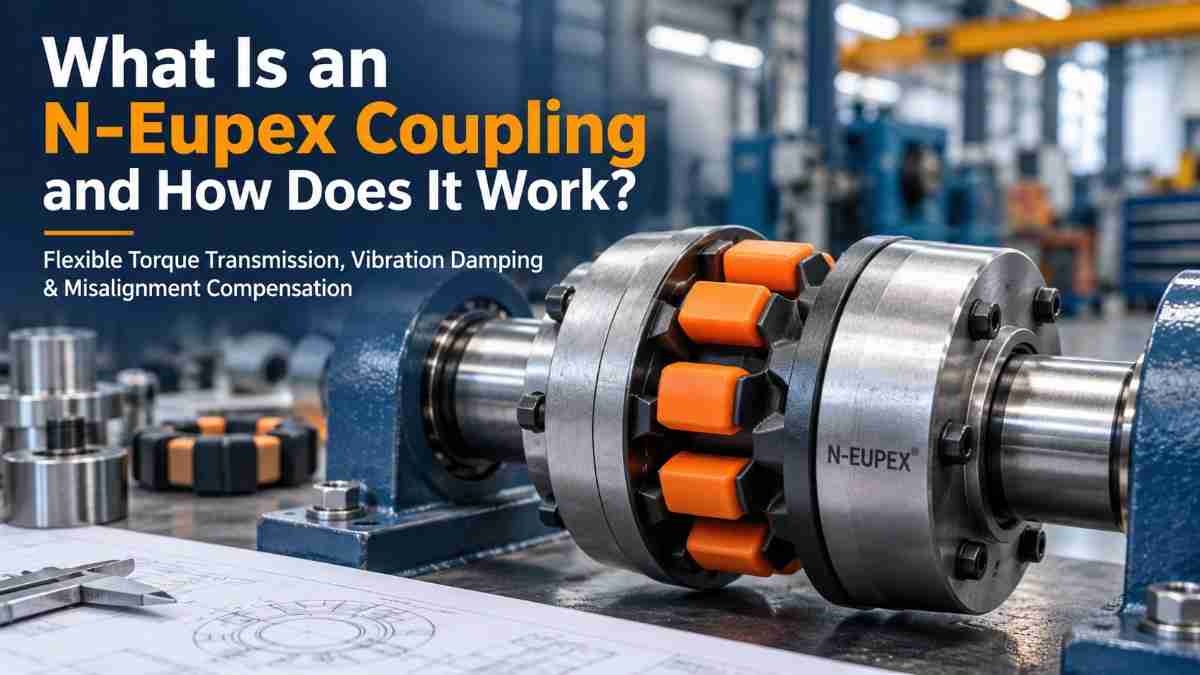
An N-Eupex coupling is a flexible shaft coupling used to transmit torque between two rotating shafts.
Unlike a completely rigid connection, it includes elastic elements that help absorb vibration, shock loads, and limited misalignment.
This makes it suitable for industrial machines where operating conditions are not perfectly constant.
An N-Eupex coupling connects a driving shaft to a driven shaft through hubs and flexible elements.
When the driving shaft rotates, torque passes through the coupling to the driven side.
The flexible elements deform slightly during operation, allowing the coupling to absorb vibration and compensate for small alignment variations.
The exact design can vary, but an N-Eupex coupling generally includes:
The flexible element is one of the most important parts because it helps reduce shock and vibration between the connected shafts.
Flexible elements allow limited movement between the connected hubs instead of transmitting every vibration or shock directly from one shaft to another.
This can help reduce:
The material and stiffness of the flexible element should match the torque and operating conditions of the machine.
Small alignment differences are common in industrial machinery, especially after installation, thermal expansion, foundation movement, or long-term operation.
An N-Eupex coupling can accommodate limited:
However, the coupling should not be used to compensate for severe alignment errors.
Proper shaft alignment remains essential for reliable operation and long service life.
Excessive shaft misalignment can create additional forces throughout the drive system.
This may contribute to:
A flexible coupling can tolerate small deviations, but alignment should still be checked during installation and maintenance.
The elastomer elements inside the coupling act as a flexible interface between the driving and driven equipment.
Instead of transferring all torsional vibration directly through a rigid connection, the flexible material can absorb part of the vibration and reduce its transmission.
This can be particularly useful in machines that experience fluctuating loads or frequent starts and stops.
Yes. One of the main reasons flexible couplings are used is their ability to reduce the effect of sudden torque changes.
Shock loads can occur during:
The flexible element can help cushion some of this impact before it reaches connected shafts and equipment.
N-Eupex couplings can be used across a wide range of industrial machinery.
Common applications may include:
They are especially useful where equipment needs flexible torque transmission rather than a completely rigid shaft connection.
Yes. Flexible couplings are commonly installed between motors, gearboxes, and driven machinery.
For example, an N-Eupex coupling can connect a motor shaft to an industrial gearbox while helping absorb vibration and minor alignment variation between the two units.
The coupling must be selected according to torque, shaft diameter, speed, and service conditions.
Both products transmit torque between shafts, but they use different mechanisms.
An N-Eupex coupling relies on flexible elements to absorb vibration and limited misalignment.
A gear coupling uses meshing gear teeth between the hubs and sleeves.
Gear couplings can handle very high torque and are widely used in heavy-duty machinery, while flexible elastomer couplings are often preferred where vibration damping is especially important.
A spacer coupling includes an extended section between the two shaft connections.
This creates additional distance between the driving and driven equipment and can make maintenance easier in some installations.
A spacer coupling may be selected where equipment requires additional shaft separation or easier access to pumps, seals, or other components.
An N-Eupex coupling is generally more focused on flexible torque transmission and vibration absorption.
Coupling size should be selected based on actual operating requirements rather than only shaft diameter.
Important factors include:
A coupling that is too small may wear prematurely, while an unnecessarily oversized coupling can increase cost and rotating mass.
Higher rotational speeds increase dynamic forces and make balance, alignment, and coupling condition more important.
The selected coupling must be rated for the machine's maximum operating speed.
At high speeds, incorrect installation or excessive misalignment can create strong vibration and accelerate bearing or coupling wear.
Torque rating is one of the most important selection criteria.
The coupling should be able to transmit normal operating torque as well as short-duration peak loads that may occur during startup or process changes.
Service factors are often applied when equipment experiences:
Selecting only for average torque can result in premature coupling failure.
Coupling failure can result from installation, operating, or maintenance problems.
Common causes include:
Routine inspection can help identify early signs of wear before the coupling causes equipment downtime.
Flexible elements should be inspected regularly and replaced when signs of deterioration appear.
Warning signs may include:
The correct inspection interval depends on operating hours, load, environmental conditions, and manufacturer recommendations.
In many coupling designs, the flexible elements are replaceable wear components.
This can reduce maintenance cost because the metal hubs may remain in service if they are still in good condition.
The machine should be shut down safely and the coupling inspected before replacement to confirm that there is no additional damage.
Coupling life can be improved through proper selection, installation, and maintenance.
Best practices include:
A coupling should be treated as part of the complete power transmission system rather than as an isolated component.
An N-Eupex coupling can be a suitable option when your machinery requires flexible torque transmission combined with vibration damping and limited misalignment compensation.
It is particularly useful in motor-driven industrial systems where rigid shaft connections could transmit excessive vibration or shock to bearings and connected equipment.
ASAR Engineering supplies N-Eupex couplings along with gear couplings, spacer couplings, industrial gearboxes, and other transmission components for industrial machinery.
The correct coupling should always be selected according to torque, shaft size, operating speed, alignment conditions, and the duty cycle of the machine.