Twin screw extruders are widely used in industries where materials need to be transported, mixed, kneaded, melted, dispersed, or processed continuously. The performance of these machines depends heavily on the screw elements installed along the shafts.
Different twin screw elements perform different functions inside the extruder. Some move material forward, while others increase mixing, pressure, dispersion, or residence time. Selecting the correct configuration can improve processing efficiency, product consistency, and equipment life.
ASAR Engineering manufactures twin screw elements and related industrial screw components for applications across plastics, chemicals, food processing, pharmaceuticals, and other manufacturing sectors.
Twin screw elements are modular components mounted on the shafts of a twin screw extruder.
Instead of manufacturing the entire screw as one continuous piece, many twin screw systems use individual elements arranged in a specific sequence.
Each element can perform a different processing function, such as:
This modular design allows the screw configuration to be adjusted according to the material and production process.
Twin screw elements rotate on two parallel shafts inside the extruder barrel.
As the screws rotate, the elements transport material through different processing zones while applying controlled shear, pressure, and mixing.
The exact behavior depends on:
Changing the sequence of screw elements can significantly alter the way material behaves inside the extruder.
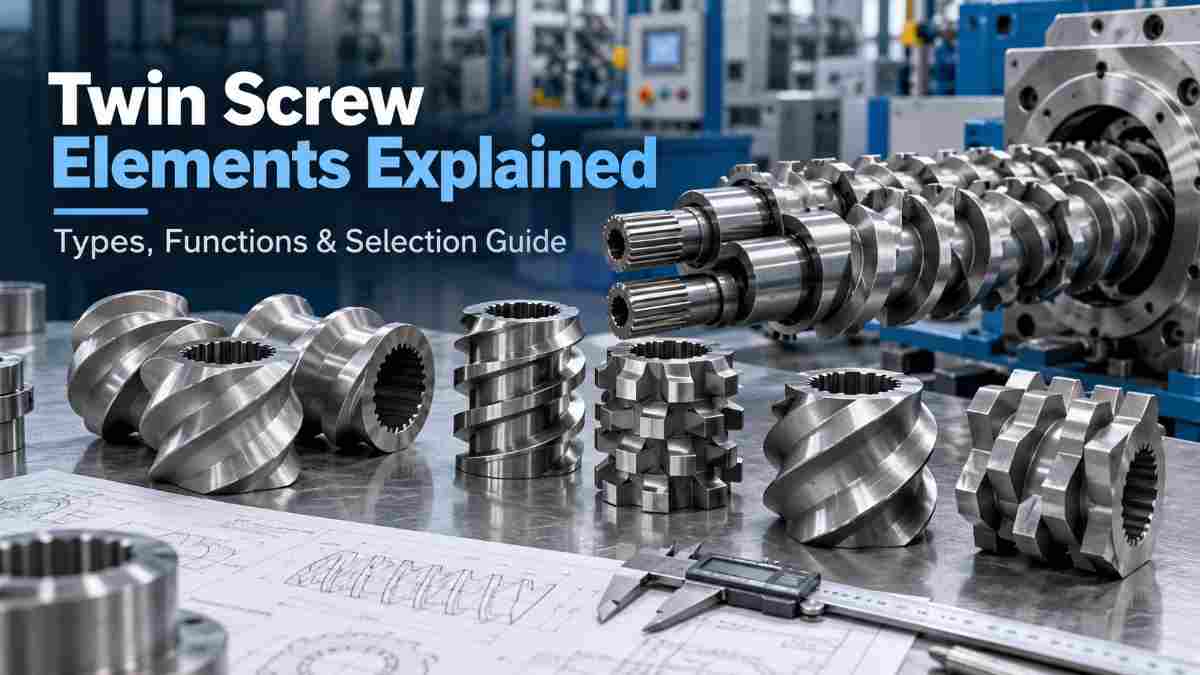
Twin screw systems can use several types of modular elements, each designed for a particular processing function.
Common categories include:
The correct combination depends on the material being processed and the required final product characteristics.
Conveying elements are primarily designed to move material forward through the extruder.
Their geometry helps determine how quickly the material travels and how much free volume is available inside the screw channel.
Conveying elements are commonly used in:
Pitch and flight geometry can be adjusted to control material movement and pressure development.
Kneading elements are designed to provide stronger mixing and shear than standard conveying elements.
They typically consist of multiple discs positioned at specific angles relative to one another.
Kneading elements can help with:
The number of discs and their offset angle influence the intensity of mixing.
Conveying elements are mainly responsible for transporting material through the machine, while kneading elements are designed to increase mixing and shear.
A twin screw configuration usually needs both.
If too many conveying elements are used, mixing may be insufficient. If too many aggressive kneading elements are installed, the material may experience excessive heat or shear.
The objective is to create a balanced screw profile for the intended process.
Reverse elements are designed with geometry that opposes the normal forward flow of material.
This creates resistance and can increase pressure or residence time in a particular section of the extruder.
Reverse elements may be used to:
Because they restrict forward flow, reverse elements should be selected carefully to avoid excessive pressure or temperature.
The order and type of screw elements determine how the material is processed as it travels through the barrel.
A screw configuration can influence:
Two extruders using the same raw material can produce different results if their screw configurations are different.
Screw pitch describes the distance between corresponding points on successive flights.
A larger pitch generally provides more conveying capacity and free volume, while a smaller pitch can increase compression and pressure.
The appropriate pitch depends on:
Different pitches may be used along the same screw shaft to create different processing zones.
The angle between kneading discs affects how aggressively material is mixed.
Different disc offsets can alter forward conveying, neutral mixing, or backward resistance.
More aggressive arrangements can increase shear and mixing intensity, but they can also increase:
The correct kneading angle should therefore match the material and desired processing result.
Twin screw extrusion is used for a wide range of materials.
Applications may include:
The screw element design must be selected according to the physical and thermal characteristics of the material.
A single screw extruder uses one rotating screw, while a twin screw extruder uses two interacting screws.
Twin screw systems can provide stronger mixing and greater control over complex material processing.
Single screw systems are widely used for more straightforward conveying and extrusion applications.
ASAR Engineering also manufactures components for single screw extruders, allowing different screw systems to be selected according to production requirements.
The material used for screw elements must withstand mechanical loads, heat, friction, and wear.
Depending on the application, materials may include:
Material selection becomes especially important when processing abrasive fillers, glass fibers, corrosive chemicals, or high-temperature compounds.
Abrasive materials can cause rapid wear on standard screw surfaces.
Applications involving materials such as mineral fillers or glass-filled polymers may require higher wear resistance.
Suitable material selection can help reduce:
The best material depends on the actual abrasiveness, temperature, and operating load.
Screw element wear can result from both mechanical and chemical conditions.
Common causes include:
Wear usually develops gradually and can affect product quality before a complete component failure occurs.
Several operating changes can indicate screw wear.
Signs may include:
Dimensional inspection can help determine whether the elements remain within acceptable wear limits.
As elements wear, the clearance between the screw and barrel can increase.
This may reduce conveying efficiency and change the shear applied to the material.
As a result, manufacturers may experience:
Replacing worn components at the appropriate time can help maintain stable production conditions.
Service life can be improved through correct component selection and process control.
Useful practices include:
The most durable element is not necessarily the best in every location, so materials and geometry should be matched to individual processing zones.
Industrial screws cover a much broader range of screw components used for material handling, feeding, extrusion, and mechanical processing.
Twin screw elements are specifically designed as modular components for twin screw extrusion systems.
ASAR Engineering also produces industrial screws for applications that require specialized material movement and processing.
Feed screws are designed primarily to move material through a machine at a controlled rate.
They are commonly used in extrusion, molding, dosing, and industrial feeding equipment.
A feed screw may be selected based on material characteristics, required throughput, diameter, length, pitch, and process conditions.
Twin screw elements offer additional modularity and mixing capability when more complex processing is required.
Before placing an order, confirm the technical specifications of the existing extruder and the process.
Important details include:
Providing accurate dimensions and operating information helps reduce compatibility issues.
Yes. Because twin screw systems are often designed around specific materials and processes, customized elements may be required.
Customization can involve:
Custom manufacturing can be useful when replacing existing components or optimizing an extrusion process.
The right elements should be selected according to what needs to happen to the material at each stage of the extruder.
Start by defining:
Conveying elements can be used where efficient forward transport is required, while kneading or mixing elements can be introduced where additional shear and dispersion are needed.
ASAR Engineering supplies twin screw elements, industrial screws, single screw extruder components, and feed screws for different industrial processing applications.
A properly designed screw configuration can improve material flow, mixing consistency, production stability, and the overall life of extrusion equipment.