Both timing belt pulleys and roller chain sprockets provide positive, non-slip mechanical synchronization between a driving shaft and one or more driven shafts. However, choosing the wrong drive system for an industrial machine can cause premature tooth wear, excessive noise, belt jumping under shock loads, or lubrication contamination in clean environments. Understanding how synchronous toothed pulleys compare against single- and multi-strand roller chain sprockets helps machine builders and plant maintenance teams select the most reliable transmission drive.
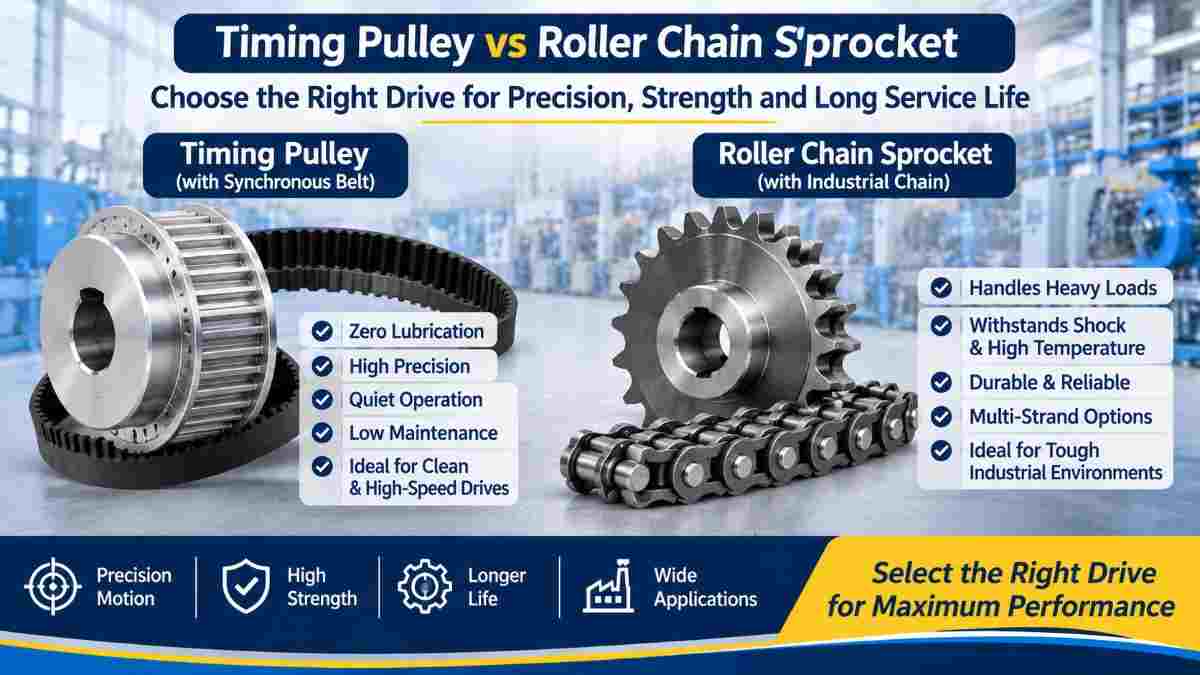
A timing pulley meshes with the molded elastomeric or polyurethane teeth of a synchronous belt to deliver quiet, lubrication-free, zero-backlash motion at high speeds, whereas a roller chain sprocket engages steel chain rollers to transmit much higher tensile loads, shock forces, and torque in rugged, dusty, or high-temperature industrial environments.
Across synchronous drive assemblies, both systems maintain a fixed speed ratio without the creep or slippage found in flat or V-belt drives. The decision comes down to operating environment and load intensity: timing belts excel in clean, high-speed positioning and indexing equipment, while metallic roller chains and sprockets dominate heavy bulk handling, continuous conveyor lines, and high-torque industrial machinery.
You should choose a timing pulley when an application requires zero lubrication, minimal rotational backlash, high linear belt speeds, quiet operation, and low maintenance in packaging, printing, pharmaceutical, food processing, or CNC automation machinery.
Precision-machined aluminum, steel, or cast-iron Timing Pulley profiles—available in trapezoidal (MXL, XL, L, H, XH) and curvilinear (HTD 3M, 5M, 8M, 14M) tooth pitches—engage belt teeth smoothly with negligible friction loss. Because synchronous belts require no oil or grease and never stretch significantly over their service life, timing pulley drives keep cleanroom and food-grade production lines free from lubricant contamination while maintaining repeatable indexing accuracy.
Heavy-load, dusty, wet, and high-temperature drives rely on roller chain sprockets because hardened steel teeth and articulating chain rollers withstand severe shock loads, abrasive debris, and ambient heat that would quickly shear or degrade polymer timing belts.
When torque requirements exceed single-strand limits, engineers step up from a single-row Simplex Sprocket to a double-row Duplex Sprocket or triple-row triplex configuration to multiply load capacity without enlarging sprocket outer diameter. Pairing precision-cut Industrial Chain Sprocket assemblies with heavy-duty Industrial Transmission Chain ensures dependable power transfer across cement plants, sugar mills, steel rolling lines, bucket elevators, and agricultural equipment.
Accurate tooth-flank geometry prevents chain-roller climbing and belt-tooth ratcheting, while selective induction hardening on steel sprocket teeth dramatically slows pitch-line wear and prevents premature chain elongation.
When sprocket teeth wear into a hooked profile, new roller chains rapidly stretch to match the damaged pitch—doubling replacement costs. Through our in-house Induction Hardening Service, steel sprocket tooth flanks are heated and quenched within seconds to achieve high surface hardness while keeping the hub bore and keyway tough and machinable.
When ordering replacement timing pulleys or chain sprockets, buyers should specify tooth pitch or chain standard (ANSI/BS), number of teeth, strand count, hub configuration (pilot bore, finished bore, or taper-lock), bore diameter, keyway size, set-screw positions, flange requirements, and base material grade.
Providing exact pitch, hub projection, and keyway tolerances ensures replacement drives mount directly onto existing motor and gearbox shafts without alignment shimming or field rework. If a worn sample has lost its stamped markings, measuring center-to-center pin pitch and roller or tooth width allows our engineering team to reverse-engineer the exact profile.
Asar Engineering Pvt. Ltd. manufactures custom timing pulleys, simplex, duplex, and triplex roller chain sprockets, and hardened steel gears in-house at our Gandevi, Gujarat unit—building from your CAD drawing, technical specifications, or worn sample part.
Operating since 2015 on National Highway 48 in Gandevi, Gujarat with a branch office in Goregaon, Mumbai, we supply OEMs and industrial plants across India and global export buyers under IEC, MSME, and GST registrations, verifying tooth pitch, bore concentricity, and runout before dispatch. You can explore more selection and maintenance guides on our Technical Guides & Articles page. Have a timing pulley or chain sprocket drawing ready for quotation? Contact Us, call +91-9898059219, or email info@asarengineering.com with your pitch, tooth count, bore size, and quantity today.