
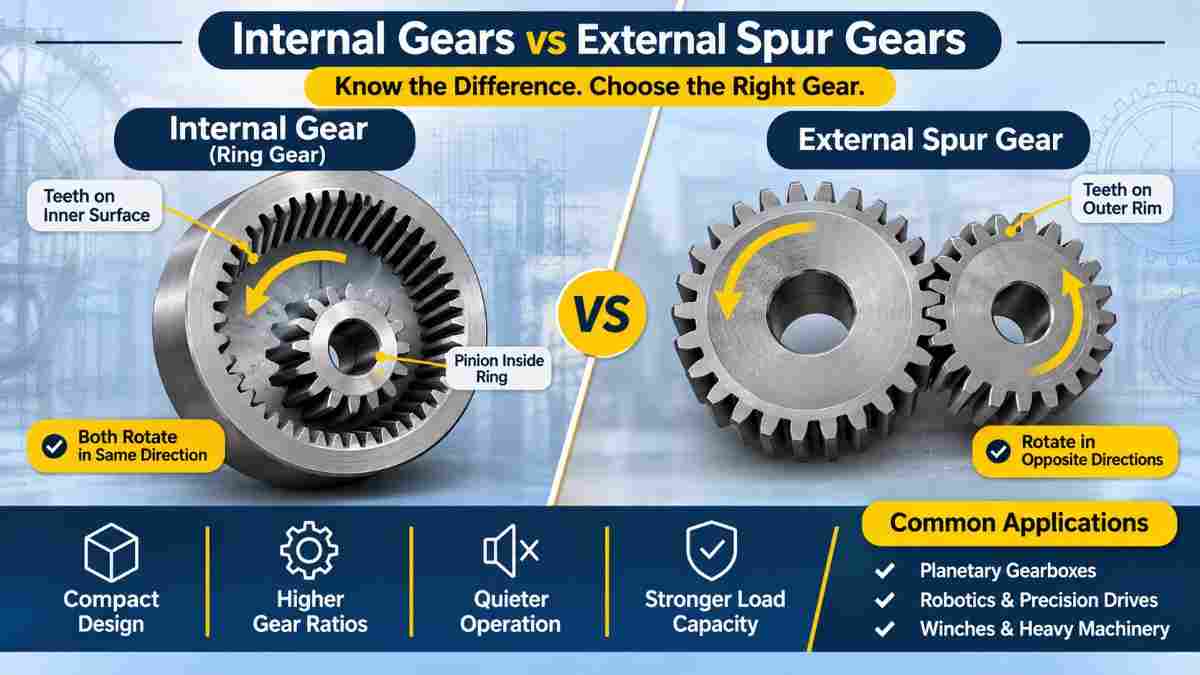
Designing compact, high-ratio power transmissions inside tight machine housings often pushes conventional external gear layouts past their space limits. While external spur gears are straightforward and economical for standard parallel-shaft drives, internal ring gears allow a mating pinion to mesh inside a hollow toothed ring—saving radial space, reducing noise, and enabling higher gear ratios in a smaller footprint. Understanding how internal gears compare against external spur gears helps engineers and OEMs design more compact, durable drives.
An internal gear has teeth cut on the inner concave surface of a cylindrical ring that mesh with an external pinion inside it so both components rotate in the same direction, whereas an external spur gear has teeth on its outer convex rim that mesh with another external gear to rotate in opposite directions.
Across our transmission gear offerings, this geometry difference changes both shaft layout and tooth contact mechanics. Because an internal ring gear wraps partially around the mating pinion, concave-to-convex tooth contact creates a larger contact area and lower contact stress than two convex external teeth pressing together—supporting smooth, quieter operation in enclosed drives.
Internal gears achieve shorter center distances because the pinion sits inside the ring rather than beside it, while the tooth-count relationship between the larger ring gear and smaller pinion allows higher speed reduction within a compact housing diameter.
In tight mechanical enclosures—such as robotic joints, winches, slewing mechanisms, hoists, and precision actuators—reducing center distance without sacrificing torque capacity is a major design advantage. When paired with a precision-machined Pinion Shaft or planet carrier, an Internal Gear packs high reduction ratios and strong load-bearing capacity into spaces where side-by-side external gears would require an oversized housing.
Internal ring gears are widely used in planetary gear sets, industrial gearboxes, winches, heavy-duty machinery, robotics, and precision mechanisms where compact high-torque reduction, same-direction rotation, and lower operating noise are required.
In planetary transmissions, the stationary or rotating internal ring gear works with the sun gear and planet gears to share torque across multiple load paths in a balanced, space-saving unit. Meanwhile, standard external Spur Gear sets remain the practical choice for open or straightforward parallel-shaft drives—such as machine tools, conveyors, pumps, and compressors—where external meshing and simple assembly are preferred.
When requesting a custom or replacement internal gear quotation, buyers should specify internal pitch or root diameter, module (such as within 0.5 to 30), number of internal teeth, face width, outer ring blank diameter, mounting holes or keyways, accuracy standard (DIN, AGMA, BS, or IS), and material grade.
Selecting the right metallurgy—such as alloy steel, pre-hardened steel, stainless steel, or engineering plastic—depends on torque, operating speed, and corrosion or lubrication conditions. Sharing exact tooth geometry, mating pinion details, and surface-hardness requirements ensures the finished ring gear meshes cleanly with minimal backlash or vibration.
Asar Engineering Pvt. Ltd. manufactures custom internal gears, external spur gears, pinion shafts, and transmission components for domestic industrial buyers and export markets—building to your CAD drawing, technical specifications, or worn sample part.
Operating since 2015 with our manufacturing unit at Gandevi, Gujarat on National Highway 48 and our branch office in Goregaon, Mumbai, our team supports machine builders and plant maintenance teams across India and worldwide. You can explore more selection and maintenance guides on our Technical Guides & Articles page. Have an internal gear or spur gear requirement ready for quotation? Contact Us, call +91-9898059219, or email info@asarengineering.com with your module, tooth count, dimensions, and quantity today.