If you've ever stood next to a running crusher, a cement mill, or a long conveyor line in a steel plant, you already know one thing — heavy machinery doesn't forgive weak components. The whole system can be brilliantly engineered, but if the transmission gear inside it isn't right, you'll feel it in the noise, the vibration, the bearing temperatures, and eventually in your maintenance bill.
In our 11+ years of manufacturing industrial transmission gears at Asar Engineering, one pattern has stayed consistent across every industry we've supplied — from Bharat Forge and JSW to Godrej and Coromandel. The plants that take their gear selection seriously run longer, break down less, and spend a lot less on unplanned downtime.
This blog walks you through exactly how industrial transmission gears influence the performance of heavy machinery, what to look for when choosing them, and where most plants quietly lose efficiency without realising it.
In simple words, a transmission gear is the part of your machine that decides three things:
A motor on its own produces high-speed, low-torque rotation. That's almost never what heavy equipment needs. A rolling mill, a sugar mill, a stone crusher, a kiln drive, a long-belt conveyor — all of these need high torque at controlled, often lower, speeds. The gear is the bridge between the motor's output and the machine's real-world demand.
Get this bridge right, and the machine runs smooth for years. Get it wrong, and you pay for it every shift.
Here are the practical, measurable ways a good gear changes the performance of heavy equipment. These aren't theoretical points — they're things our clients see on the shop floor after switching to precision-engineered gears.
A correctly designed gear system multiplies torque. Instead of buying a bigger, more power-hungry motor to handle a heavy load, the gear reduction does the heavy lifting. This is one of the biggest cost-saving aspects of industrial transmission systems — you achieve the required output with a smaller, more efficient drive.
For mining drives, ball mills, and bulk material handling equipment, this difference alone can cut energy bills significantly over a year.
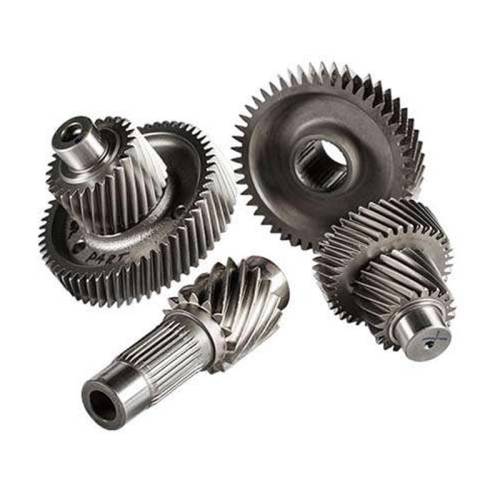
This is where gear type matters a lot. A poorly chosen spur gear in a high-speed application will rattle, vibrate, and wear out bearings prematurely. Switch to a helical gear — where the teeth are angled — and the engagement becomes gradual. More teeth share the load at any moment, vibration drops, and the noise level falls noticeably.
For continuous-duty equipment like extruders, blowers, and conveyor drives, this single change extends bearing and seal life by a large margin.
Heavy machinery isn't gentle. Shock loads from crushers, sudden reverses in winches, and unbalanced loads on conveyors all put massive stress on the drivetrain. A well-cut gear with proper case hardening absorbs these shocks instead of passing them on to shafts, couplings, and bearings.
At our facility, we use induction hardening to give gears a hard, wear-resistant surface while keeping the core tough enough to handle impact. That combination is what allows our gears to survive in real industrial conditions — not just lab conditions.
In industries like pharma, food processing, plastic extrusion, paper, and textiles, the speed of motion is as important as the torque. A gear system gives you exact, predictable speed ratios. Whether you need a 5:1 reduction for a mixer or a 60:1 reduction for a kiln, the gear ratio is what makes the process repeatable, batch after batch.
This is also why worm gears and helical gearboxes are so common in process plants — they deliver high reductions in compact, reliable units.
Many heavy machines need the power to turn at 90° or at an offset angle. This is where bevel gears, spiral bevel gears, and hypoid gears earn their place. Spiral bevel gears, for instance, transmit power between intersecting shafts with much less noise and vibration than straight bevels — and hypoid gears handle even more torque because of their offset axis design.
Without these gears, layout flexibility in plants like cement, sugar, and paper would simply not be possible.
A precision-cut gear running in the right lubrication can hit transmission efficiencies of 96–99% per stage. A worn or poorly manufactured gear can drop that by 5–10%. That lost energy doesn't disappear — it becomes heat, vibration, and noise. Multiply that across a 24/7 operation and the difference in electricity cost alone is significant.
This is why heavy industries increasingly insist on AGMA, DIN, or IS-standard gears rather than cheap, locally cut alternatives.
Every plant manager knows that an unplanned shutdown costs ten times more than a planned one. High-quality industrial gears, properly heat-treated and lubricated, can run for years with only routine oil checks. Compare that to substandard gears that pit, chip, and break unexpectedly — usually right in the middle of a production run.
Our clients in steel, fertiliser, and cement have repeatedly told us the same thing: switching to a properly engineered gear set didn't just reduce maintenance, it changed how they plan it.
There's no single "best" gear — only the right gear for the right job. Here's a quick practical guide based on what we manufacture and supply at Asar Engineering:
| Gear Type | Best Suited For | Common Applications |
|---|---|---|
| Spur Gears | Parallel shafts, moderate speed | Winches, lifts, pumps |
| Helical Gears | High-speed, high-load, quiet operation | Compressors, conveyors, extruders |
| Bevel & Spiral Bevel Gears | Shaft direction change (mostly 90°) | Mills, process drives, mixers |
| Hypoid Gears | High torque with offset shafts | Heavy automotive, industrial drives |
| Worm Gears | High reduction in small space, self-locking | Hoists, elevators, packaging machines |
| Herringbone Gears | Heavy-duty, low vibration, high load | Turbines, marine drives, rolling mills |
| Rack and Pinion | Converts rotary motion to linear motion | CNC machines, presses, material handling |
| Planetary Gears | High torque in compact body | Robotics, mining, automation |
If you're not sure which one suits your machine, this is exactly where talking to an experienced manufacturer saves a lot of guesswork — and money.
After 11+ years in this business, here's the honest truth — most gear failures aren't because of design. They happen because of these three things:
A quality industrial gear should come with the right material grade (typically EN-series alloy steels, case-hardened or induction-hardened), accurate machining to international standards (AGMA, DIN, IS, BS), and a profile checked on proper gear testing equipment. At our manufacturing unit in Gujarat, every gear we deliver goes through this discipline — because we know our gear will end up inside someone's mission-critical machine.
Industrial transmission gears directly affect productivity in:
If you operate in any of these sectors, the gear inside your equipment is a much bigger productivity lever than most people realise.
We're not the only gear manufacturer in India — and we don't claim to be. But here's what we bring to the table:
We treat every gear as if it's going into our own machine — because in a way, our reputation does ride on every single one we deliver.
Start by sharing your application details — load (in kW or HP), input and output RPM, shaft orientation, duty cycle, and environment. Based on that, the right gear type and ratio can be selected. Our engineering team helps clients with this evaluation regularly.
Helical gears engage gradually because of their angled teeth, so they run quieter, smoother, and handle higher loads. Spur gears are simpler and cheaper, but they're better suited for lower-speed applications. For most continuous-duty heavy machinery, helical gears are the preferred choice.
With proper material selection, accurate machining, correct lubrication, and right load matching, an industrial gear can easily last 8–15 years or more, depending on duty cycle. Many of our gears installed years ago are still running without replacement.
Yes. A large portion of our work is custom-built gears made to client drawings or based on reverse engineering of existing components. Material, hardening process, and finish are all chosen to match the actual operating conditions.
Yes — we manufacture in-house at our Gujarat facility, so clients buy directly without dealer markups. You can request a quote on +91-9898059219 or through our website.
A heavy machine is only as strong as the smallest gear inside it. The right industrial transmission gear doesn't just transmit power — it improves efficiency, extends machine life, lowers your energy bill, and keeps unplanned breakdowns away from your production schedule.
If you're planning a new installation, upgrading an existing drivetrain, or simply tired of recurring gear failures in your plant, talk to us. We'd much rather help you choose the right gear once than replace the wrong one three times.
Asar Engineering Pvt. Ltd.
Industrial Transmission Gear Manufacturers in Mumbai | Established 2015
Phone: +91-9898059219
Website: www.asarengineering.com
Manufacturing Unit: Kharel, Gujarat | Branch Office: Goregaon, Mumbai