
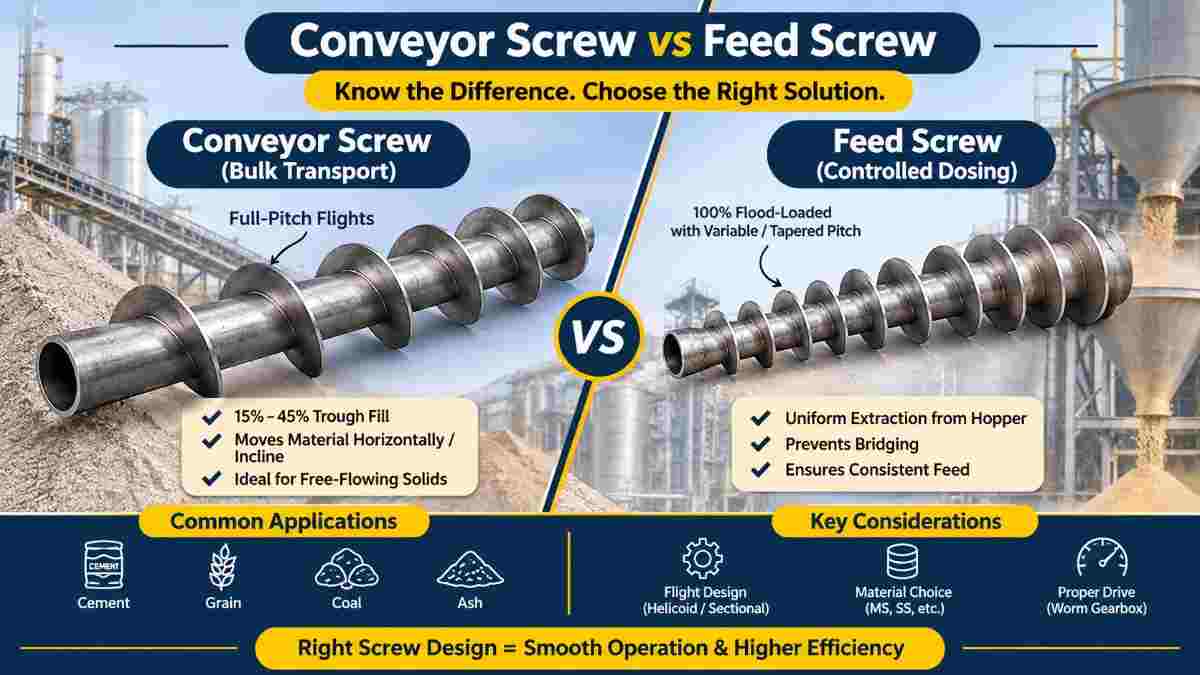
Selecting between a standard conveyor screw and a precision feed screw is essential when designing or replacing bulk material handling equipment in cement, sugar, chemical, power, and food processing plants. Although both components use helical flights welded onto a central pipe or shaft to move powders, granules, and semi-solids, their flight pitch geometries and volumetric fill ratios serve completely different operational purposes. Specifying the wrong screw design leads to hopper bridging, uneven discharge rates, motor overload, and rapid flight abrasion.
A conveyor screw transports bulk material horizontally or along an incline at a controlled trough fill percentage using standard full-pitch flights, whereas a feed screw operates 100% flood-loaded beneath a hopper or bin using short-pitch, variable-pitch, or tapered flights to meter material uniformly without bridging.
Across bulk-handling systems in our Industrial Screw range, the distinction comes down to transport versus controlled extraction. A transport conveyor receives pre-metered material and moves it from point A to point B at trough fill levels typically between 15% and 45%. By contrast, a hopper feeder must draw material evenly across the entire bin opening under full head pressure, requiring specialized flight geometry to prevent stagnant dead zones.
You should specify a standard conveyor screw when transferring free-flowing or moderately sluggish bulk solids—such as cement, fly ash, grain, coal, bagasse, or dewatered sludge—from a controlled inlet point to one or more discharge gates along a U-trough or tubular housing.
In continuous transport lines, a Conveyor Screw typically uses a uniform pitch equal to its outer flight diameter, keeping material moving steadily while leaving upper trough clearance to prevent shaft and hanger-bearing jamming. For sticky, fibrous, or cohesive materials like wet sludge or pulp, engineers can also specify ribbon flights—where an open gap between the helical blade and center pipe prevents material buildup—or cut-and-folded flights to promote gentle mixing during transit.
Hopper-fed dosing and metering systems require variable-pitch or tapered-diameter feed screws because a constant-pitch screw operating flood-loaded beneath a bin extracts material almost exclusively from the rear wall, causing rat-holing, uneven bin drawdown, and surging discharge rates.
By progressively increasing flight pitch—or tapering the flight outside diameter—along the length of the hopper outlet, a Feed Screw creates expanding pocket volume toward the discharge end. This progressive capacity draws bulk solids uniformly across the full length of the hopper opening while maintaining a consistent volumetric feed rate into downstream mixers, kilns, extruders, or packaging scales.
You should choose continuous helicoid flights for light- to medium-duty conveying of dry, moderately abrasive powders and grains, whereas heavy-duty sectional flights are required for thick-plate construction, large diameters, high-torque drives, and severely abrasive materials such as clinker, ore, coal, and sand.
Helicoid flights are cold-rolled from a continuous steel strip—producing a smooth, seamless helix whose thickness tapers slightly from the inner hub to the outer tip. Sectional flights are individually formed from flat steel plates—each spanning a single pitch—and butt-welded along the center pipe, maintaining uniform full plate thickness all the way to the outer wear edge and accommodating hardfacing overlays or wear-resistant alloy plates.
When requesting a custom or replacement screw quotation, buyers should specify outer flight diameter, center pipe outer diameter and wall thickness, overall shaft length, flighted length, pitch configuration, flight thickness, rotation hand, end-shaft journal and keyway dimensions, and material grade.
Matching the metallurgy to the handled product prevents premature corrosion and abrasive wear: mild steel or abrasion-resistant alloy grades serve dry cement, ash, and aggregates, while stainless steel SS 304 or SS 316 is specified for food ingredients, pharmaceuticals, fertilizers, and wet washdown lines. Pairing the screw shaft with a properly sized Worm Reduction Gearbox ensures sufficient starting torque when extracting dense materials under full hopper load.
Asar Engineering Pvt. Ltd. manufactures custom conveyor screws, variable-pitch feed screws, ribbon screws, and replacement shafts in-house at our Gandevi, Gujarat unit—building to your CAD drawing, dimensional sketch, or worn sample screw.
Operating since 2015 on National Highway 48 in Gandevi, Gujarat with a branch office in Goregaon, Mumbai, we supply cement, sugar, chemical, food, power, and bulk-handling plants across India and global export buyers under IEC, MSME, and GST registrations, verifying straightness, pitch accuracy, and end-journal tolerances before dispatch. You can explore more selection and maintenance guides on our Technical Guides & Articles page. Have a conveyor or feed screw drawing ready for quotation? Contact Us, call +91-9898059219, or email info@asarengineering.com with your diameter, pitch, length, material grade, and quantity today.